


News

EVP Jeff Thornton at Transwestern Conference: ‘Opportunity Lives Amid Market Volatility’
Search Site
Back to Menu
"We have a long-term view of the industrial business, and CenterPoint has always had that throughout its 30-year history. Even with all the chop in the market right now – especially because of it – we take a longer-term view when we’re thinking about what we’re buying, what we’re selling and what we’re building.”
- Jeff Thornton, CenterPoint's EVP, Central Region
Thornton and fellow experts express optimism in the near- and long-term future of industrial real estate in the face of prolonged economic uncertainty.
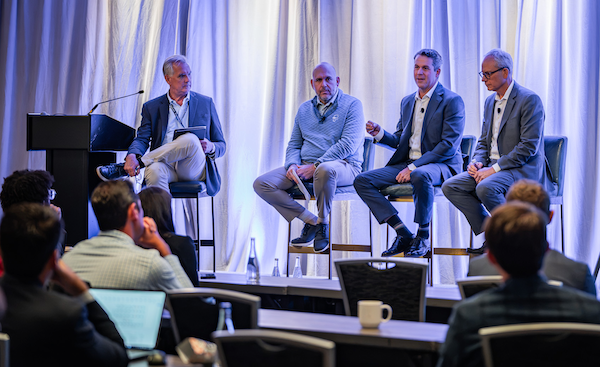
After several years of extraordinary growth followed by rising interest rates and shifting economic conditions, the industrial real estate market is finding a new equilibrium. That was a central theme of a capital markets panel at Transwestern’s Fall Services event in Chicago, where Jeff Thornton, CenterPoint Properties’ Executive Vice President and Head of the Central Region, offered a long-term view of where the sector is headed alongside Richard Prokup, CEO, United States, at Mapletree, and Tom Fishman, EVP at Hillwood.
The message from Thornton: Industrial isn’t weakening. It’s normalizing.
“We came off this big party after COVID. We built a lot of buildings and leased them at elevated rental rates,” Thornton said. “We’re normalizing right now, and what we’re feeling is the chop from some things that are outside our control. We have a long-term view of the industrial business, and CenterPoint has always had that throughout its 30-year history. Even with all the chop in the market right now – especially because of it – we take a longer-term view when we’re thinking about what we’re buying, what we’re selling and what we’re building.”
That normalization is bringing greater discipline to capital markets, but Thornton said CenterPoint’s long-term investment horizon allows the company to look beyond short-term volatility. During the panel, he pointed to Atlanta, Dallas-Fort Worth, and Southern California as markets where CenterPoint sees opportunities to grow.
That philosophy is especially evident in CenterPoint’s recent investment activity in the Central Region, which comprises nearly 24 million square feet of space across 83 assets in Chicago, Dallas-Fort Worth, Houston, and Austin, Texas.
In April 2026, CenterPoint acquired two newly built, fully leased distribution facilities at 11217 Telephone Road in Houston’s South Belt submarket. The buildings total 192,318 square feet and combine proximity to the Port of Houston with features including an outdoor storage yard, shallow-bay configurations, 4,000-amp power, and parking for 318 cars.
CenterPoint has also expanded in Dallas-Fort Worth in 2026. Its acquisition of a newly constructed, 103,803-square-foot Class A facility at 15277 Heritage Parkway marked the company’s first investment in Fort Worth and eighth in the broader DFW market. Located near I-35W, Alliance Airport, the Alliance Intermodal facility, and DFW International Airport, the property reflects CenterPoint’s emphasis on transportation access and high-quality, strategically located facilities.
Those investments align with another trend Thornton emphasized: customers increasingly value modern functionality and infrastructure. He said CenterPoint’s investment, leasing, and development teams nationwide are reporting higher clear heights, greater power capacity, improved truck courts, trailer storage, and operational efficiency among the attributes driving a continued flight to quality by industrial customers.
Power, in particular, could become an increasingly important differentiator.
“If you’re adjacent to power, you’ve got some embedded value there that’s tradable,” Thornton said, emphasizing that the trend extends beyond data centers to advanced manufacturing and automation.
Richard Prokup of Mapletree similarly pointed to technology, manufacturing, trade policy, and supply chain disruption as multiple sources of logistics demand. Unlike the pandemic-era boom, he argued, today’s demand cannot be attributed to one dominant trend. “There’s not one area you can point to and say, ‘This is our bubble,’” Prokup said. “I think that means this market is going to have legs.”
Tom Fishman of Hillwood added that the market for large-scale facilities has shown renewed momentum, telling the audience that bulk leasing has “really, really woken up.”
For Thornton, those trends reinforce the importance of filtering out short-term capital-market noise and focusing on the enduring value of industrial real estate.
Asked by the panel moderator Walter Boyd from Transwestern, where CenterPoint expects to stand as a buyer or seller over the next year, Thornton didn’t hesitate: “Net buyer, for sure.”
It was a fitting conclusion to his broader outlook. Even in a more disciplined market, strategically located industrial real estate serving major population centers, logistics networks, and evolving customer needs continues to offer compelling long-term opportunities.
For CenterPoint Investment, Development, and Asset Management inquiries in the Central Region, please contact:
Subscribe
Microsite Request